Chengdu: Three Pop-Up Retail Domes, Built in Three Days and Taken Down Again
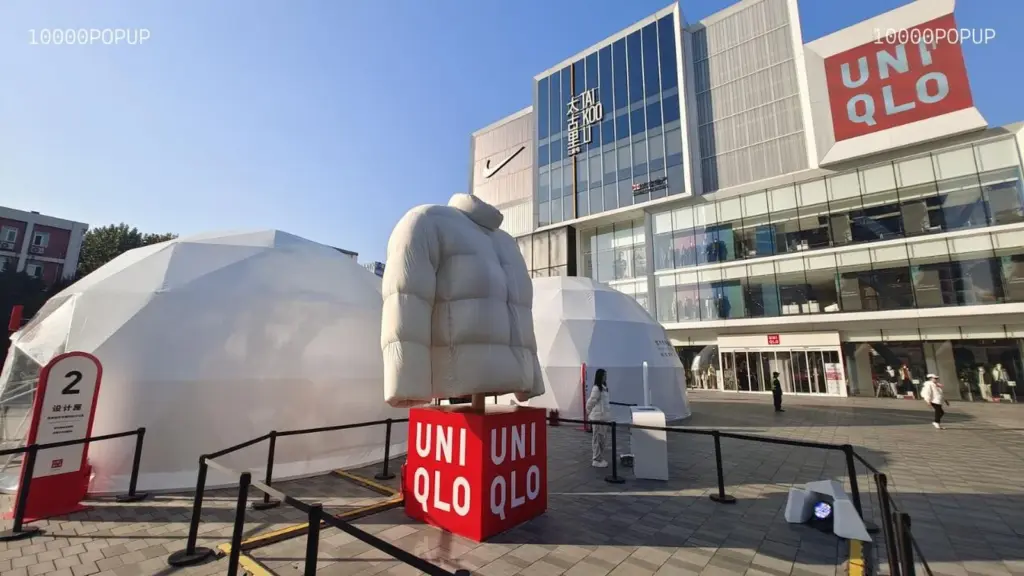
Three geodesic domes — 5 m, 6 m and 7 m across — on a shopping plaza in Chengdu. Three days to build. One brand campaign inside them. Then they came down, went into storage, and are ready to go up again.
The brief
A retail pop-up has two problems a permanent shop does not.
It has to look finished on the opening morning, because the brand is judged in the first photograph. And it has to leave the plaza exactly as it found it, because the site is borrowed.
Most temporary structures solve the first problem and fail the second. They are built to be erected once: the panels are sealed, the frame is painted, the connections assume a crane and a week. Take one down and you have a pile of parts that will not go back together the same way.
This client asked the second question up front — can it be reused, not just removed.
Why three sizes
The three domes do three different jobs, which is why they are not the same size.
The 7 m unit is the display: the brand object, the thing that is photographed from the escalator. The 6 m unit is the experience — the space people walk into, which needs enough headroom for a lighting rig and enough floor to stand a queue without blocking the entrance. The 5 m unit is the working one: stock, staff, the things a customer never sees.
Sizing by function rather than by symmetry is what keeps the footprint small. Three identical 7 m domes would have occupied the plaza and left nothing for circulation.
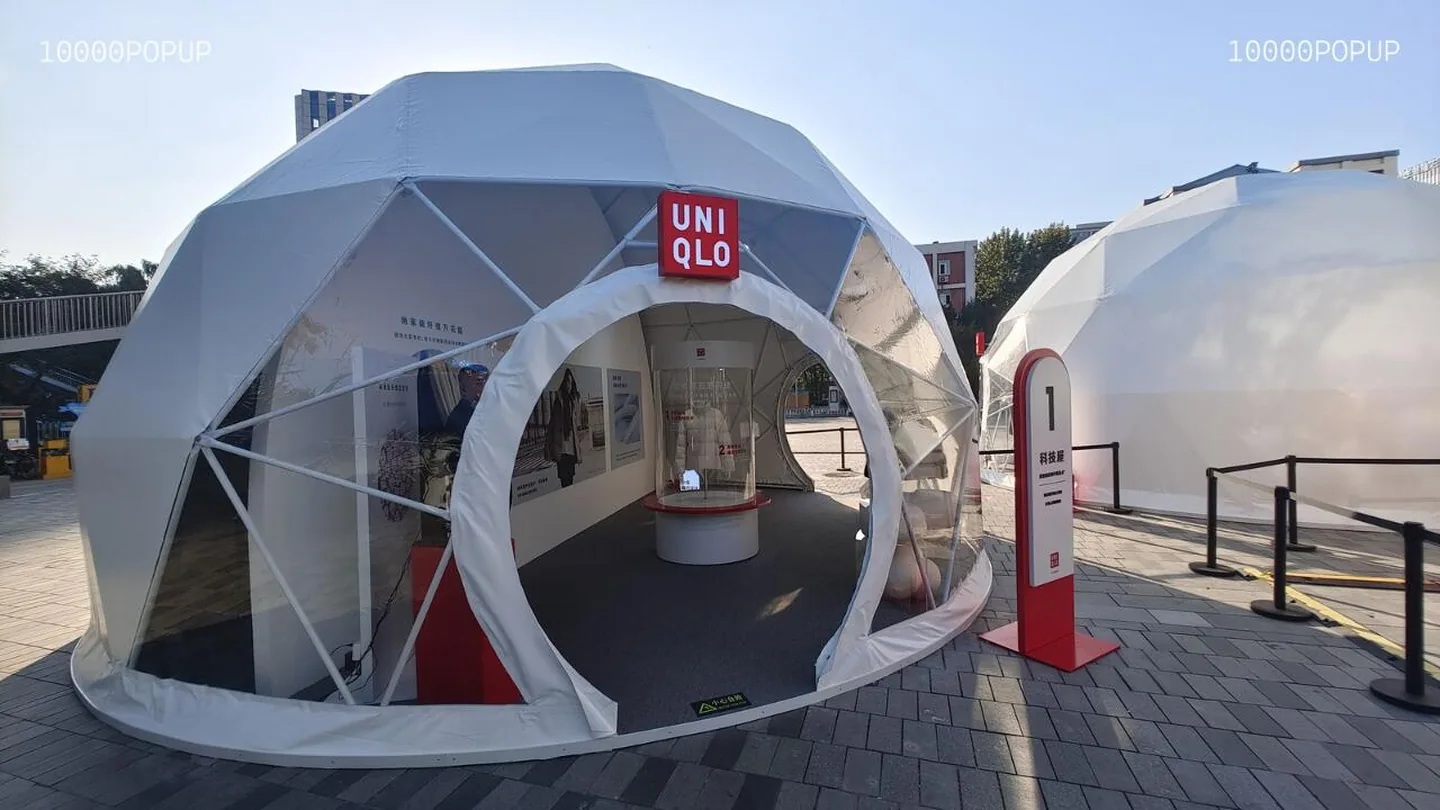
The 7 m unit from the plaza. The dome does the signage work before a single poster is printed.
Why a dome for a pop-up
It reads as a brand object, not a tent. A box with a printed wall is a kiosk. A dome is a shape, and a shape is what gets photographed.
No scaffolding inside. The clear span means the display can be built on the floor and lit from above, without a single post in the customer's path.
It closes fast. The frame goes up as arcs from the ring beam outward, the membrane follows in numbered panels. A dome of this size closes its roof in a day, which leaves the rest of the programme for glazing, flooring and services.
Three days, and then three days again
The build was three days, for three units.
The number that matters more is the second one: taking them down, and putting them up somewhere else without the tent being the worse for it.
Reusable is a design decision, not a claim. It comes down to four things:
Numbered panels. Every membrane panel matches one position in the frame. Pack them in order and the next build is assembly; pack them loose and the next build is a puzzle.
Bolted connections, not sealed ones. Every joint that has to come apart is a bolt with a known torque, so nothing is cut, welded or glued on site.
A frame that tolerates handling. Galvanised or coated steel that is designed to be carried, stacked and re-erected does not lose its finish at the corners, which is where temporary structures fail first.
A membrane that folds rather than creases. Tensile membrane packs flat. The damage on a reused tent is almost never the fabric — it is the packing.
None of that is visible in a photograph. All of it is the difference between a structure the client buys once and a structure the client rents twice.
What actually wears out
Worth being straight about, because every supplier claims reusability:
What wears is the handling, not the material. Scuffed frame corners, membrane packed wet, panels folded along a hard edge, fixings dropped in grass. What does not wear is the geometry — a geodesic frame re-erects to the same shape every time, which is why the second build looks like the first.
That is also the argument for buying rather than hiring: after the second or third use, the structure has paid for the hire it replaced, and it is still the client's asset.
Inside
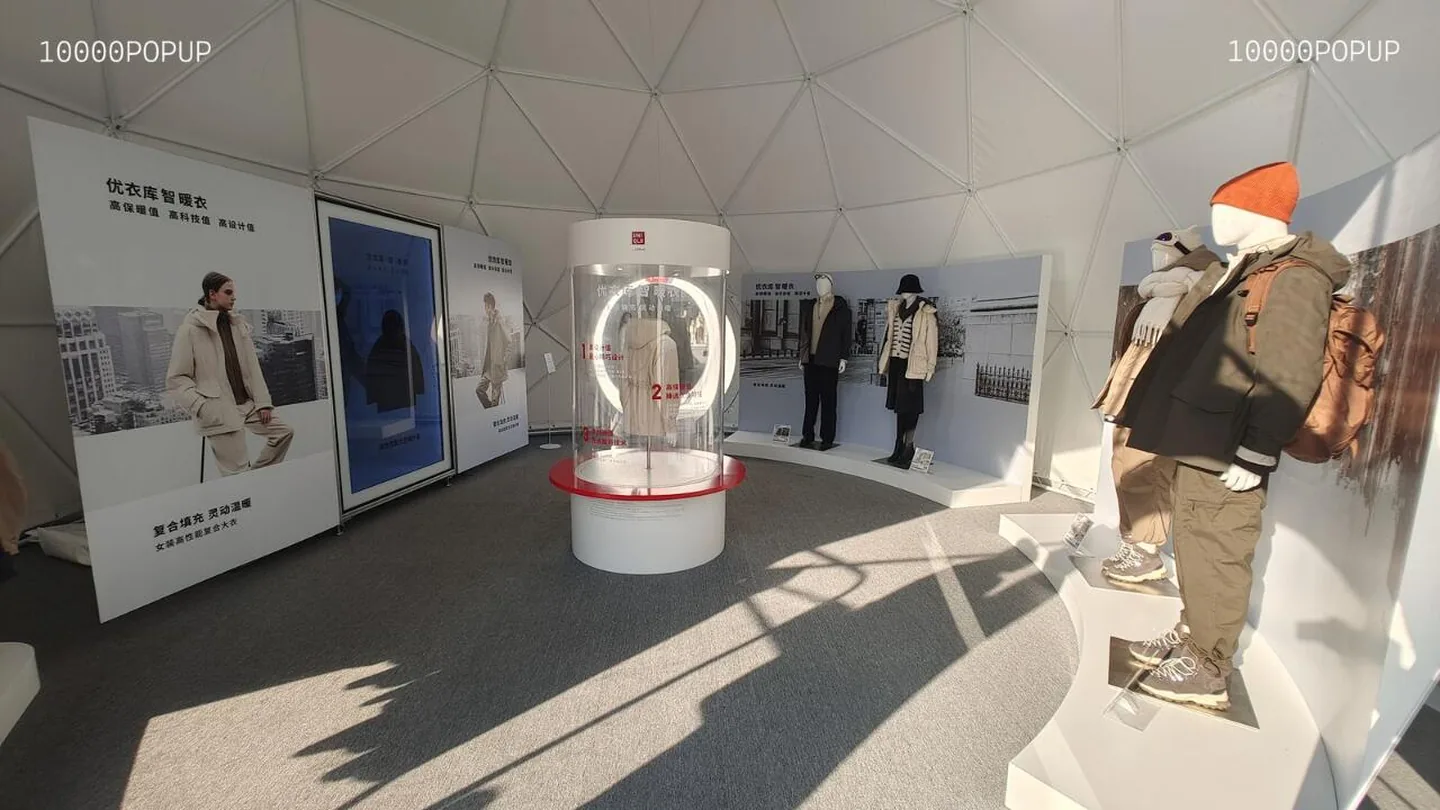
Inside the 6 m unit: clear span, no columns, lighting rig overhead.
The interior is a single clear volume. Display fixtures stand on the floor rather than being fixed to a wall, because there is no wall — the envelope curves away from the floor line.
Glazed entrances do the work of a shopfront. A fabric flap says tent; a glass door says shop, and the difference is decided before a customer reads a single word of the branding.
Why not a marquee
A marquee is cheaper per square metre and quicker to quote. It is also the wrong shape for a brand.
A marquee is a box with a pitched roof, and every box on a plaza reads as a temporary stall — the same structure the local market uses. The client was not renting floor space; they were renting the impression that the brand had built something.
The dome also solves a practical problem a marquee does not: wind. A plaza between buildings funnels gusts, and a flat-sided marquee at 7 m spans needs a lot of anchoring and still moves. A curved shell turns the gust, which is why the units sat on the plaza for the length of the campaign without a ballast ring big enough to be visible in the photographs.
Three days is a factory outcome
The site work is assembly. Nothing is measured on site that should have been measured in the factory, and nothing is cut on site at all.
That is why the schedule holds on a plaza with a fixed handover date: the crew is not making decisions, it is following a panel list.
What this project taught us
Reuse is decided in the drawings, not in the sales pitch.
Three sizes beat three of the same. Sizing by function keeps the footprint small and the circulation clear.
A shape photographs better than a box. For a brand, the silhouette is part of the media budget.
Glass doors change how the structure is read. A tent with a flap is a tent; the same tent with a glass door is a shop.
Packing is the maintenance item on any relocatable structure.
Specification
| Item | Value |
|---|---|
| Units | 3 |
| Diameters | 5 m, 6 m, 7 m |
| Floor area | ~19.6 m², 28.3 m², 38.5 m² |
| Structure | Geodesic dome, no internal columns |
| Envelope | Opaque membrane with glazed entrance |
| Use | Retail pop-up (UNIQLO) |
| Installation | 3 days on site |
| Reuse | Dismantled after campaign, no damage, re-erectable |
| Completed | September 2023 |
Planning a pop-up that has to come down again?
Send us the site, the number of units and how many times you expect to rebuild. You will get back a layout and a packing plan, not just a price.